Minor Arcana · Swords
Ten of Swords
an ending, collapse, and the moment the truth can no longer be avoided, while asking you not to drift into holding on to the pain of an ending long after the event itself has passed.
Upright and Reversed at a Glance
an ending, collapse, and the moment the truth can no longer be avoided
holding on to the pain of an ending long after the event itself has passed
What This Card Is Really Saying
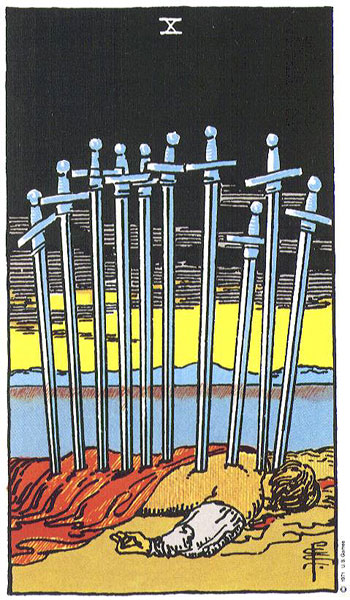
Ten of Swords often shows up when an ending, collapse, and the moment the truth can no longer be avoided is the real thing in front of you. In the image, a fallen figure lies beneath ten swords while dawn begins to break on the horizon. Because it belongs to the suit of Swords, it keeps the reading grounded in thought, language, conflict, and truth; because it sits at the Ten stage, it also says something precise about timing and development.
Ten of Swords combines an ending, collapse, and the moment the truth can no longer be avoided with the suit of thought, language, conflict, and truth. Tens describe the end of a cycle: completion, burden, fulfillment, or the need to release what has become too much. Upright, the card usually asks for a cleaner expression of that energy. Reversed, it can slip into holding on to the pain of an ending long after the event itself has passed. Reversed, the ending can drag on, the burden can overstay, or completion can be resisted.
In practice, this kind of card rarely talks in abstract destiny language. It talks about response. Are you naming what is happening honestly enough to work with it? Are you adjusting your approach, or repeating a habit just because it is familiar? The minor arcana are often at their best when read as practical behavior instead of background mood.
When This Card Shows Up in Love
In love, Ten of Swords tends to highlight communication, misunderstanding, and hard truths. Its core theme is an ending, collapse, and the moment the truth can no longer be avoided, so upright it asks for a clearer expression of that theme, while reversed it asks you to watch for holding on to the pain of an ending long after the event itself has passed. In love, it asks whether the relationship has become richer, heavier, or ready for a new form.
When This Card Shows Up in Career or Decisions
In career or decisions, Ten of Swords tends to highlight strategy, pressure, discernment, and clear expression. Its core theme is an ending, collapse, and the moment the truth can no longer be avoided, so upright it asks for a clearer expression of that theme, while reversed it asks you to watch for holding on to the pain of an ending long after the event itself has passed. In work, it often points to delivery, peak workload, or the final accounting of a long effort.
When This Card Shows Up for Health or Mind
In health or mindset, Ten of Swords tends to highlight stress, mental loops, and nervous-system overload. Its core theme is an ending, collapse, and the moment the truth can no longer be avoided, so upright it asks for a clearer expression of that theme, while reversed it asks you to watch for holding on to the pain of an ending long after the event itself has passed. For health, it asks where endurance has crossed into excess.
Journal and Reflection Prompts
- What is Ten of Swords asking me to face more honestly right now?
- Where am I repeating holding on to the pain of an ending long after the event itself has passed?
- If I follow the thread of an ending, collapse, and the moment the truth can no longer be avoided, what is the most practical next step?
- Which part of thought, language, conflict, and truth have I been neglecting lately?
Quick Questions
Is Ten of Swords a good tarot card?
Ten of Swords is not most useful as a simple good-or-bad card. It is more useful as a card about an ending, collapse, and the moment the truth can no longer be avoided; reversed, that same theme leans toward holding on to the pain of an ending long after the event itself has passed.
What is the difference between Ten of Swords upright and reversed?
Upright, the stage expresses itself more cleanly. Reversed, it gets tangled with holding on to the pain of an ending long after the event itself has passed. The difference is less about whether the issue exists and more about how it is being handled.
Want to pull a reading yourself?
Go back to the homepage, choose a spread, and let the cards answer your question directly.
Return to the homepage